Umar Hayat for Mayor Umar Hayat for Mayor

Umar Hayat

Innovation for All Winnipeggers

A new kind of leadership for a smarter, safer, more affordable Winnipeg.

Meet Umar

Umar Hayat is a community advocate, real estate professional, and Winnipegger who has called this city home since immigrating from Kuwait with his family during the early 1980s.

Umar holds an MBA from the American International College, specializing in marketing. He is a member of the Canadian Real Estate Association (CREA), Manitoba Real Estate Association (MREA), and the Winnipeg Regional Real Estate Board (WRREB).

Umar is deeply committed to community service, volunteering his time with organizations such as St. Amant Centre, Winnipeg Harvest, and Siloam Mission. His dedication to public service led him to run for Mayor of Winnipeg in 2018, and he is now ready to bring his vision of an innovative, transparent, and accountable city government to life.

Why he's running: "It is very important to care about politics because you should know what is going on around you. The political decisions people make will affect many lives. I believe we can do better - better roads, better public safety, better housing, and a government that actually works for the people."

Umar Activism Umar Handshake Umar Speech

The Plan for a Smarter Winnipeg

Fix Roads Smarter

14,500+
Potholes filled spring 2026
273,000
Potholes filled in 2025
Live
Real-time map updates

Problem: Winnipeg fills potholes reactively β€” waiting for complaints, then sending crews. The city doesn't have real-time data on which neighbourhoods need the most attention. Over 14,500 potholes filled this spring alone. 273,000 in 2025. Drivers pay the price in blown tires and suspension damage.

What the city is missing: A real-time pothole density map that updates daily, not annually. We built it. Pavement Predictor shows exactly which streets are deteriorating fastest, so crews can fix problems before they become emergencies. The tool already exists. The city just isn't using it.

Umar's Solution: Deploy the Pavement Predictor city-wide on Day 1. Give public works crews real-time data on where to focus repairs. Measure results by neighbourhood. Hold the department accountable for response times.

⬆️ Interactive demo - click "Enable Voice" and enter a destination to see pothole density along your route. Allow location access for GPS tracking.

Soundbite: "The city fills potholes based on complaints. That means someone has to hit the pothole first. I'll give them a map that shows where the next pothole will form before anyone gets a flat tire."

Launch Full App β†’

Crisis Response Drones

$155k
Already spent on police drone (2019)
$2M
Annual helicopter operating cost

What you need to know: The Winnipeg Police Service already bought an infrared drone in 2019 using proceeds of crime. The city has approved a $13.5M helicopter lease β€” a decision already made. Police admit drone technology is coming. They admit federal line-of-sight restrictions are loosening. They're waiting.

The problem with waiting: Every year we wait, we spend $2M on a helicopter that takes 20 minutes to arrive. A drone costs $15,000 once and takes 90 seconds.

Umar's Solution: Accelerate the transition. Deploy industrial drones from existing fire stations to reach emergencies in 90 seconds. Winnipeg police already use drones. I'm not asking them to start. I'm asking them to scale up.

Drone Specifications: DJI Matrice 30T

  • Response time: 90-120 seconds to any location within 5km
  • Cost per unit: ~$15,000 (one-time)
  • Capabilities: Thermal camera, loudspeaker, spotlight, 4G/5G connectivity, medical kit deployment
  • Deployment locations: 8-10 fire stations across Winnipeg

🩺 Accessibility & Emergency Medical Delivery

For Winnipeggers with mobility limitations or medical conditions, getting help quickly can be the difference between life and death. Drones can carry epi-pens, naloxone, first aid kits, and even automated external defibrillators (AEDs) directly to a person in distress β€” without waiting for an ambulance to navigate traffic or find parking. A 90-second drone response can stabilize a patient until paramedics arrive. This is faster, cheaper, and more accessible than any terrestrial alternative.

Soundbite: "Winnipeg police already have a drone. They already want to replace the helicopter. They're just waiting. I'm not willing to wait while people die."

MyWinnipeg App

Problem: 311 is outdated. Reports disappear into a black hole. There's no transparency, no tracking, no accountability. The same can be said for the union grievance process β€” members file complaints and never know what happened next.

Umar's Solution: The MyWinnipeg App - a modern, real-time platform that brings city services into the 21st century. Already live and functional.

⬆️ Live demo of the MyWinnipeg Incident Map - showing real WFPS emergency calls, crime data, and user reports. LIVE DEMO

Current Features (Already Built):

  • πŸ“ Real-time incident map - WFPS emergency calls, Winnipeg Police crime data, user-submitted reports
  • πŸ“± Report incidents with photo/video - GPS and timestamp auto-extracted from your media
  • πŸš‘ View emergency wait times - Urgent Care and Emergency Department wait times
  • 🚌 Winnipeg Transit integration - Real-time bus schedules and stop finder
  • πŸ—ΊοΈ 311 property information - Snow zones, garbage collection, property assessments
  • 🚨 WPS Crime Map - Interactive crime statistics dashboard
  • πŸ₯ Healthcare resources - QDoc virtual care, crisis helplines, extended hours clinics
CUPE 500 Grievance Tracking

What's happening right now: CUPE 500 members file grievances and then wait β€” sometimes weeks, sometimes months β€” with no visibility into where their case stands. Is it pending review? Has management responded? Is it scheduled for arbitration? Most members never find out unless they chase down their union rep.

What other unions are doing: Unions across North America are already using digital grievance tracking. SEIU Local 6 in Washington migrated from disconnected legacy systems to a unified platform, eliminating manual data synchronization and saving significant time and resources. United Public Employees in Sacramento County replaced two disconnected systems with a centralized grievance dashboard, eliminating duplicate data entry and reducing the need for manual deadline tracking. Over 40 union locals now trust similar platforms, and the technology is proven.

What the city is doing: Nothing. The current grievance process remains paper-based, opaque, and frustrating for everyone involved. There is no central database, no member portal, no automated deadline tracking, and no way to identify patterns across grievances.

Umar's Solution: Build a CUPE 500 grievance tracking system using the same proven technology stack that already powers MyWinnipeg, the Pavement Predictor, and the mayoral nomination signature page. The building blocks already exist:

Signature Page
Repurpose for grievance intake
Admin Dashboard
Track and assign cases
Status Tracking
Real-time updates for members
Email Notifications
Automatic status change alerts
Role-Based Access
Member vs. steward vs. admin
Audit Trail
Complete case history

What a CUPE 500 grievance dashboard would look like:

#G-2026-042 - Shift scheduling violation Filed: May 10, 2026
#G-2026-041 - Overtime pay dispute Under Review Filed: May 8, 2026
#G-2026-039 - Unsafe working conditions Resolved Resolved: May 5, 2026

What this would deliver:

  • βœ… Members - File grievances online, track status in real time, receive automatic email updates, and never wonder "what happened to my case?"
  • βœ… Stewards - Manage assigned cases from a single dashboard, attach documents, add notes, and never miss a deadline with automatic reminders
  • βœ… Union Leadership - Run reports to identify patterns (e.g., 60% of grievances from one department), spot problematic supervisors, and use hard data at the bargaining table
  • βœ… Transparency - Every action is logged with timestamps and audit trails, creating a defensible record for arbitration

The bottom line: The technology already exists. The building blocks are already built. The nomination signature page, the admin review dashboard, the incident reporting system β€” these are all modular components that can be reassembled into a grievance tracking system in weeks, not months. CUPE 500 members deserve the same transparency and accountability that MyWinnipeg provides to Winnipeg residents.

Built on the same proven architecture as MyWinnipeg β€” already live and working today. Deployable in weeks, not years.

Launch MyWinnipeg App β†’

Affordable Container Housing

8+
Years vacant lots on Furby Street
$60k
Container home cost
60
Days to build

What's happening right now: Spence neighbourhood residents are begging the city to do something with the vacant lots on Furby Street. They've been empty since 2018. The residents want infill housing. They're offering to be a pilot neighbourhood. The city is doing nothing β€” waiting, studying, deferring. Meanwhile, people sleep in tents.

What the city is doing: Nothing. Waiting. Studying. Meanwhile, Spence residents look at vacant lots every day while encampments grow along the riverbanks.

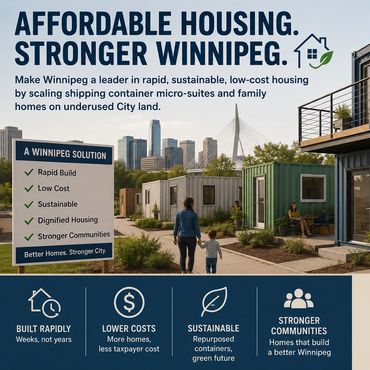
Umar's Solution: Container homes. Built in 60 days. Not 6 years. Not 8 years. 60 days.

The Numbers:

  • 🏠 40ft shipping container - Converted into 1-2 bedroom unit (500-800 sq ft)
  • πŸ’° Cost per unit: $50,000-70,000 fully finished (vs $300,000+ traditional)
  • ⏱️ Build time: 30-60 days from lot prep to occupancy
  • πŸ—ΊοΈ First location: Furby Street, Spence neighbourhood (residents are asking for it)

πŸ—οΈ Federal Funding through Transit Adjacency

The Canada Public Transit Fund (CPTF) provides $3 billion annually over 10 years β€” but requires cities to actively plan for affordable housing near frequent transit pipelines. By locating container housing within 800 metres of bus routes, the project becomes eligible for up to 40% federal capital cost coverage. Manitoba's matching programs can add another 20%. This means 60% of the cost could be covered by senior governments β€” leaving the city's share at 40%, offset by long-term savings on emergency services, shelters, and healthcare.

The strategy: Build housing where transit already exists. Unlock federal dollars. Solve homelessness faster.

πŸ•οΈ Ending Encampments, Not Managing Them

The current stalemate: Winnipeg is stuck between two failed approaches to encampments. Managed tent encampments cost $700,000 to $1.4 million per season. The city rejected them. Traditional affordable housing takes five years to build and costs $300,000 per unit. The province added just 16 of 1,020 promised housing units in two years. At that pace, we would add just 64 units by 2031. The result: people stay in unmanaged, dangerous encampments. Water main breaks happen twice as often here as the North American average. Fires spread. Medical emergencies go untreated. The city manages decline and calls it governance.

The Village Project proved container housing works in Winnipeg. In 2021, Winnipeg built 22 container homes near Thunderbird House β€” a village of lockable, private units arranged in a circle around a shared fire pit. Residents had their own door, their own bathroom, their own space. The project was designed by listening to people living in encampments. They said they wanted privacy, safety, community, and cultural safety. The Village Project delivered all four. The only problem was cost β€” $272,000 per unit was too expensive to scale.

Our plan scales the Village Project at one-fifth the cost. Same dignity. Same lockable door. Same private bathroom. Same community design. $60,000 per unit instead of $272,000. 60-day build time instead of years. Federal transit-adjacent dollars instead of one-off grants.

πŸ“Š Container Housing vs. The Alternatives

  • πŸ•οΈ Managed tent encampment: $700k-$1.4M per season β€” tents, no lockable doors, temporary, low dignity. The city rejected this.
  • πŸ—οΈ Traditional affordable housing: $300,000+ per unit β€” permanent, high dignity, but takes 2-5 years. The province added just 16 units.
  • 🏠 The Village Project (container housing): $272,000 per unit β€” permanent, high dignity, 60 days. Proven but too expensive to scale.
  • πŸ’° Umar's container housing: $60,000 per unit β€” permanent, high dignity, 60 days, federal funding eligible. Scalable, affordable, proven.

🀝 What About Main Street Project and St. Boniface Street Links?

The city currently funds Main Street Project as its exclusive 24/7 mobile outreach provider under a contract renewed in March 2026. The contract requires compliance with the city's encampment protocol β€” meaning outreach workers help enforce removals from parks, playgrounds, and transit shelters. Main Street Project has citywide capacity, operates 24/7, and has held this contract since 2021.

St. Boniface Street Links previously shared outreach funding but lost the exclusive contract in 2025. They still receive $250,000 annually for a 24/7 safe space at 604 St. Mary's Road, leased for $1 per year. Their outreach work now relies on a $2.5 million anonymous donation because their programs do not currently qualify for funding through any existing government agreements.

The results speak for themselves. Street Links housed 986 people in 36 months β€” an average of 2 people per day β€” and projected exceeding 600 placements by March 2025. Of those housed, 15 percent completed recovery programs and are substance-free.

Both organizations claim to support housing. Main Street Project's executive director disputes there is a philosophical difference, saying housing first is meeting people where they are. But the city's contract prioritizes enforcement over placement β€” requiring outreach providers to help clear encampments, not just house people.

This is not a choice between two organizations. It is a failure of city policy.

  • βœ… Main Street Project has capacity. They are one of the few organizations that can operate 24/7 citywide. That matters. We should fund them appropriately β€” their executive director says the current contract is not enough.
  • βœ… Street Links has results. 986 people housed in 36 months is demonstrable success. The fact that they do this without government outreach funding is a condemnation of the city's procurement process, not a reflection on their effectiveness.
  • βœ… The east side is underfunded. The city splits funding $290,000 for the west side versus $97,000 for the east side. The founder of Street Links called this impossible, noting that $90,000 pays for two-and-a-half outreach positions to cover 24/7.

Umar's approach: Fund both organizations for what they do well. Main Street Project for 24/7 citywide capacity and enforcement coordination if enforcement must happen. Street Links for rapid housing placement on the east side. Split the contract equitably β€” not $290,000 versus $97,000. Tie funding to outcomes: how many people moved into stable housing, not how many encampments cleared.

But container housing changes the equation entirely. Right now, outreach workers have nowhere to take people. Main Street Project's workers helped set up an encampment in Point Douglas because no housing options were immediately available. That is not a failure of the organization. That is a failure of housing supply.

Container housing gives outreach workers somewhere to go. 60-day build time. $60,000 per unit. A lockable door. A bathroom. Dignity. This does not replace Main Street Project or Street Links. It gives them a tool they currently do not have.

πŸ”„ Beyond Housing: Wraparound Supports Are Essential

Housing alone is not enough. People stay in encampments for reasons that permanent housing does not automatically solve:

  • 🧠 Mental health challenges β€” shelter and housing environments can be overwhelming without proper supports
  • πŸ’Š Addiction β€” housing with abstinence requirements fails people who are not ready
  • πŸ• Pets and possessions β€” many housing options ban pets or restrict belongings
  • 🀝 Community and culture β€” isolation can be worse than encampments

Our approach: Container housing is the structure. But it must be paired with 24/7 supports β€” mental health services, addiction treatment, cultural programming, and employment assistance. The Village Project included 24/7 staff and cultural programming. We will do the same, working with Indigenous-led organizations and experienced service providers.

We will not build housing and walk away. That is not a solution. That is neglect with a nicer building.

πŸ—£οΈ What This Means For Winnipeggers

For residents near encampments: You have been asking the city to do something for years. We will. Container housing on vacant lots replaces dangerous, unmanaged encampments with safe, dignified homes. Your property values go up, not down. Your neighbourhood gets stability, not neglect.

For people living in encampments: You deserve a lockable door, a bathroom, and a place to keep your belongings without fear of theft or destruction. You deserve support, not enforcement. You deserve a pathway to stability, not a perpetual cycle of displacement.

For taxpayers: Every night someone spends in an emergency shelter costs the city hundreds of dollars. Every ambulance callout costs thousands. Every fire caused by an encampment can cost millions. Container housing pays for itself.

Soundbite: "The city rejected managed tent encampments. The province is not building housing fast enough. There is a third way. Container homes cost $60,000. They build in 60 days. They provide a lockable door, a bathroom, and dignity. The Village Project proved it works. We just need to scale it. And we will."

Support the Housing Initiative β†’

Underground Data Center & Crypto Mine

Portage & Main Underground Concourse

What's happening right now: Bell is converting a former protein plant in Rosser into a 5.5MW AI data centre. Another US-based company wants to build a data centre in Ritchot, powered by natural gas. Private corporations. Private profits. Zero benefit to Winnipeg taxpayers.

The missed opportunity: The city is about to spend $11 million to fill the Portage & Main underground concourse with concrete. Destroying an asset instead of using it. The membrane above the square has been irreparably damaged β€” the square will need to be filled with concrete regardless at a cost of $11 million. Rather than fill the entire thing, we reserve a small portion as a crypto mine.

Umar's Solution: Instead of filling the entire concourse with concrete, fill it with servers and crypto miners. The miners fit within a maximum of 5 shipping containers β€” containers that could technically be placed outdoors and stay dry. The membrane failings are not a major concern for the mines the way they are for the businesses currently in the square. Winnipeg should own its own data centre. Winnipeg should benefit from crypto mining revenue.

πŸ“Š The Economics of Portage & Main Crypto Mining

$4.59M
Upfront capital for 1,139 miners + 4MW transformer gear
4 MW
Safe power pool - total continuous electrical capacity
35.65 BTC
Generated per year (142.60 BTC over 4-year hardware lifecycle)
$911,000
Saved annually - waste heat replaces 455mΒ³ of natural gas per hour for connected skyscrapers
$965,000
Saved annually - eliminates current taxpayer cash drain to maintain and secure empty underground space
$2.31M
Total combined profit and savings per year under active industrial volume rates

The Numbers: The total cost to fill the square with concrete is $11 million. Rather than fill the entire thing, we reserve a small portion as a crypto mine. The total cost would be approximately $16 million β€” but the mine would return approximately $4 million worth of crypto per year. Sealing the public access space while protecting the mine vault saves Winnipeg another $61.86 million in avoided structural debt compared to a full $73 million membrane replacement.

Bottom line: $11.14 million to fill with concrete versus $73 million for a new membrane. The crypto mine pays for itself while generating revenue for the city β€” turning a liability into an asset.

The Plan:

  • 🏒 City-owned data centre - Not Bell. Not a US corporation. Winnipeg-owned.
  • πŸ’° Crypto mining operation - Revenue stays in Winnipeg, funding roads and housing
  • πŸ”’ Secure, underground location - Naturally secure, temperature-stable
  • ⚑ Works with Manitoba Hydro - Not against them. Crypto companies are willing to be curtailed at peak times.
  • πŸ—οΈ Preserve remaining space - As many businesses as possible can be relocated under whatever space remains with the most intact membrane.

Soundbite: "Bell is building a data centre in Rosser. An American company wants to build one in Ritchot. They'll generate profits for shareholders, not for Winnipeg. I'm proposing we build our ownβ€”under Portage & Mainβ€”with the revenue going to fix our roads."

Support Smart Downtown Development β†’

Electric Paratransit Buses

ARBOC Equess CHARGE Battery-Electric Low-Floor Transit Bus

What's happening right now: Winnipeg Transit Plus operates a fleet of aging, diesel-powered paratransit cutaway buses. These vehicles are expensive to fuel ($0.70/km), costly to maintain ($0.60/km), and rely on hydraulic lifts that frequently break down. The city is missing an opportunity to modernize its paratransit fleet while saving millions in operating costs.

What New Flyer's sister company is building: The ARBOC Equess CHARGEβ„’ is a 30-foot, battery-electric low-floor transit bus designed specifically for paratransit and community transit applications. ARBOC is a sister company to Winnipeg's own New Flyer Industries β€” the largest transit bus manufacturer in North America. This vehicle is built right here in North America, with proven technology from the same family of companies that supplies buses to cities across the continent.

30'2"
Length (9.2m)
350 kWh
Battery Capacity
210 km
Maximum Range
1033 ft-lbs
Torque (Siemens ELFA3)
10.38"
Kneeled Step Height
4
Wheelchair Positions

The federal funding opportunity: The Zero-Emission Transit Fund (ZETF) has closed, but the new Canada Public Transit Fund (CPTF) provides $3 billion annually over 10 years ($30 billion total). Winnipeg can access up to 40% federal coverage for eligible capital costs under the CPTF's Targeted Funding stream for zero-emission transit vehicles β€” including specialized paratransit fleets like Transit Plus. Combined with Manitoba's provincial green transit matching funds, the city can cover up to 60% of the upfront cost of each ARBOC Equess CHARGE bus.

πŸ’° 12-Year Lifecycle Cost Comparison (Per Bus)

$821,000
Diesel Paratransit Bus (12-year total)
$866,800
ARBOC Equess CHARGE (Gross Outlay)
-$266,000
Federal CPTF Grant (40% of eligible)
-$133,000
Provincial/Municipal Green Match
$467,800
NET LIFETIME TOTAL per bus

The savings: Despite a higher upfront purchase price ($620,000 vs $220,000), the electric bus delivers $259,200 in fuel savings over 12 years (16Β’/km vs 70Β’/km) and $120,000 in maintenance savings (30Β’/km vs 60Β’/km). The electric ramp eliminates $20,000 in hydraulic lift upkeep. After federal and provincial grants, Winnipeg saves $353,200 per bus over its lifetime β€” while providing cleaner, quieter, more reliable service.

Key Warranty Coverage (ARBOC Equess CHARGE):

Base Bus: 3 years / 75,000 miles
Bus Structure: 7 years / 350,000 miles
Propulsion System: 3 years / unlimited miles
Batteries: 6 years / unlimited miles
Wheelchair Ramp: 3 years / 15,000 cycles
LED Headlights: 6 years / unlimited miles

β™Ώ Better Service for Winnipeggers with Disabilities

Winnipeg Transit Plus exists because traditional transit is not accessible to everyone. But the current fleet of diesel cutaway buses has its own barriers:

  • Hydraulic lifts break down constantly, leaving riders stranded
  • High floor design requires complex lift mechanisms that fail in winter
  • Loud diesel engines make communication difficult for riders with hearing or cognitive disabilities
  • Rough ride quality causes pain and fatigue for riders with chronic conditions

The ARBOC Equess CHARGE solves these problems:

  • βœ… Low-floor design - No lift required. Roll on, roll off. No moving parts to fail.
  • βœ… Kneeling capability - The bus lowers to just 10 inches from the ground
  • βœ… Electric ramp - Simple, reliable, and faster than hydraulic lifts
  • βœ… Up to 4 wheelchair positions - More capacity for power chairs and mobility devices
  • βœ… Quiet electric operation - Easier communication between rider and driver
  • βœ… Smoother ride - Less vibration means less pain for riders with chronic conditions
  • βœ… Reliable in winter - No hydraulic fluid to freeze, no complex mechanisms to ice up

The bottom line: A more reliable, more comfortable, more dignified ride for Winnipeg's most vulnerable transit users. This is not just about emissions. It is about accessibility.

The implementation plan: Rather than buying an experimental block of 10 units all at once, Winnipeg can steadily replace 2 to 3 aging Transit Plus units per year using predictable baseline capital allocations from the CPTF's permanent, multi-year funding stream. The city can map out a predictable capital replacement plan through 2035, aligning bus retirements with grant cycles.

Soundbite: "New Flyer is a Winnipeg success story. Their sister company ARBOC builds the Equess CHARGE β€” a battery-electric paratransit bus that saves taxpayers over $350,000 per vehicle over its lifetime. The federal government will pay 40%. Manitoba should chip in another 20%. Winnipeg gets cleaner transit, lower operating costs, and a faster path to net-zero. This isn't complicated. Let's get these buses on the road."

Support Sustainable Transit β†’

Indigenous Advisory Committee

βš™οΈ IN DEVELOPMENT

What's happening right now: No mayoral candidate has yet addressed First Nations, MΓ©tis, and Inuit communities as a distinct constituency with unique needs and perspectives. The city makes decisions that profoundly impact Indigenous citizens β€” housing policy, policing, land use, transit, and social services β€” without dedicated, structured input from Indigenous leadership.

The gap this fills: Indigenous citizens in Winnipeg face disproportionate rates of homelessness, over-policing, child apprehension, and health crises. Yet there is no formal, elected body within the city's governance structure that gives Indigenous people a direct voice to City Hall. Advisory committees exist, but they are appointed, not elected. They lack mandate and accountability to the communities they are meant to represent.

Umar's Proposed Solution (In Development): Establish a permanent, elected Indigenous/MΓ©tis Advisory Committee β€” a board of 4 or 5 Indigenous elders, leaders, and professionals representing a blend of First Nations, MΓ©tis, and Inuit communities.

πŸ›οΈ Proposed Committee Structure

  • Size: 4-5 members (elders, leaders, professionals)
  • Representation: First Nations, MΓ©tis, and Inuit communities
  • Selection: Direct election by Status Indian Manitoba voters
  • Term: Aligned with municipal election cycle
  • Mandate: Advise the Mayor and Council on all matters affecting Indigenous citizens
  • Authority: Formal referral power on city policies, budgets, and appointments
❀️ Love (Zhaawenimaa) πŸͺΆ Respect (Manaadendamowin) 🦬 Courage (Zoongide'iwin) πŸ™ Honesty (Gwekwaadiziwin) 🌲 Wisdom (Nibwaakaawin) 🧸 Humility (Dbaadendiziwin) ✊ Truth (Debwewin)

Grounded in the Seven Sacred Teachings: The committee's work would be guided by the Seven Sacred Teachings β€” Love, Respect, Courage, Honesty, Wisdom, Humility, and Truth. These principles would inform how the committee evaluates city policies, engages with citizens, and provides recommendations to City Hall.

How it would work:

  • βœ… Indigenous citizens elect their representatives to the committee
  • βœ… The committee meets regularly with the Mayor and relevant department heads
  • βœ… The city refers specific policies, budgets, and appointments to the committee for review and recommendation
  • βœ… The committee serves as a conduit β€” gathering input from Indigenous citizens and relaying those voices directly to City Hall
  • βœ… The committee has formal standing to initiate its own inquiries and recommendations

What this is not: This is not a token advisory body. This is not a ceremonial appointment. This is a formal, elected, accountable committee with real authority to shape city policy affecting Indigenous lives.

What this is: A structural commitment to reconciliation β€” not just in word, but in governance. The city cannot claim to be acting in partnership with Indigenous communities if those communities have no formal, elected voice at the decision-making table.

"No mayoral candidate has yet addressed First Nations, MΓ©tis, and Inuit communities as a distinct constituency with unique needs and perspectives. This committee would change that. It would be elected by Status Indian Manitoba voters. It would be grounded in the Seven Sacred Teachings. And it would ensure that Indigenous voices are not an afterthought β€” they are built into the structure of city government."

β€” Umar Hayat

What's next: This concept is currently in development. The campaign is actively consulting with Indigenous elders, leaders, and community organizations to refine the committee's structure, electoral process, mandate, and funding model. The final proposal will be shaped by the Indigenous community, not dictated by City Hall.

How to get involved: Indigenous citizens and organizations interested in helping shape this initiative are encouraged to reach out to Jennifer, the campaign's Indigenous Liaison.

Share Your Input β†’

Confronting the $7.8 Billion Deficit

$12.8B
10-Year Infrastructure Need
$5.0B
Currently Funded
$7.8B
The Deficit

πŸ“‹ The Current Situation

Winnipeg's own 2024 Infrastructure Plan reveals a city that cannot afford itself. Over the next decade, we need $12.8 billion just to maintain existing roads, transit, wastewater, and recreation facilities. The city has firm funding for only $5 billion. That leaves a $7.8 billion black hole.

We are not alone β€” but we are among the worst. Every major Canadian city faces an infrastructure deficit. Toronto estimates $26 billion in unfunded needs. Calgary faces a $7.7 billion gap. Ottawa's 10-year deficit is $10.8 billion. But Winnipeg, a city one-fifth the size of Toronto, has a per-capita deficit that ranks among the highest in the country. We are not managing decline. We are accelerating toward it.

⚠️ Where the Money Is (and Isn't) Going

  • 🚌 Public Transit: Needs $1.8B over 10 years β€” only 30% funded. Deficit: $1.26B
  • 🏞️ Recreation (spray pads, pools, arenas): Needs $1.3B β€” only 6% funded. Deficit: $1.22B
  • πŸ—οΈ Building & Development: Needs $1.14B β€” almost entirely unfunded. Deficit: $1.12B
  • πŸ›£οΈ Regional Roads: Needs $3.26B β€” 43% unfunded. Deficit: $1.4B
  • ♻️ Recycling & Waste Diversion: Needs $179M β€” 0% funded

❌ What Has Been Done? Almost Nothing.

For years, city council has treated the infrastructure deficit like weather β€” something to be endured, not solved. The approach has been:

  • ❌ Patch and defer. Fix what breaks today. Push replacement to next year. Repeat.
  • ❌ Blame senior governments. Complain without building partnerships to attract funding.
  • ❌ Raise property taxes just enough to avoid crisis. The 2026 budget includes a 3.5% increase β€” the lowest among major Canadian cities, according to the mayor β€” but still not enough to close the gap.
  • ❌ Study problems to death. The Furby Street lots have been vacant since 2018. The city has studied them. It has not built on them.

The result: A $7.8 billion deficit that grows every year we delay. Water main breaks happen twice as often here as the North American average. Community centres are closing. Transit is crumbling. The city is managing decline β€” and calling it governance.

πŸ“‰ What Happens If We Do Nothing?

$20B+
Deficit by 2035 (projected)
2x
More water main breaks than average
Closures
Recreation centres, libraries, pools
  • 🏚️ More closed facilities. Recreation centres, libraries, and pools will shut permanently as they reach end of life with no replacement funding. The city's own documents show recreation is only 6% funded.
  • 🚰 More water main breaks. Winnipeg already experiences twice the North American average. Deferred replacement means more streets torn up, more businesses disrupted, more emergency repairs that cost three times as much as planned replacement.
  • 🚌 Worse transit. The $1.26 billion transit deficit means buses don't get replaced, routes get cut, and service becomes less reliable.
  • 🏠 No affordable housing. The city has no capital plan for housing because all available capital is consumed by emergency repairs.
  • πŸ“ˆ Higher taxes anyway. Emergency repairs are more expensive than planned replacement. The city will pay more for the same infrastructure β€” just later, under crisis conditions, with no flexibility.

πŸŒ† What Other Cities Are Doing (That We Aren't)

New York City just closed a $12 billion deficit in months. Mayor Zohran Mamdani inherited a massive shortfall and, through a combination of state aid and aggressive internal reforms, stabilized the city's finances. Here is what they did that Winnipeg isn't:

  • πŸ’° Audited employee health plans β€” removed ineligible dependents, saving approximately $100 million annually
  • πŸ’° In-sourced consultant and IT contracts β€” canceled a McKinsey contract saving $9M, brought IT consultants in-house saving $4.3M
  • πŸ’° Started billing for services already provided β€” FDNY began billing Medicaid for "Treat No Transport" services, saving $10.1 million
  • πŸ’° Renegotiated vendor contracts β€” FDNY renegotiated for competitive rates, saving $2.9M across two years
  • πŸ’° Consolidated office space β€” vacated underutilized office space, relocated staff, saving hundreds of thousands
  • πŸ’° Technology modernization β€” eliminated duplicate hardware and software, right-sized consultant agreements

Winnipeg can do the same. These are not cuts to frontline services. They are audits, renegotiations, and billing reforms that every major city should be doing. I will direct the Chief Savings Officer β€” a position NYC created specifically for this purpose β€” to review every contract over $500k, audit dependent eligibility, and identify services we can bill for.

βœ… Umar's Plan: Five Ways to Close the Gap

1. Internal Audits and Operational Savings (Potential: ~$10-20 million annually).

Before asking taxpayers for more money, we will find savings within city operations.

  • πŸ’° Health plan dependent audit β€” NYC saved $100M annually by removing ineligible dependents. Winnipeg can do the same.
  • πŸ’° In-source consultant contracts β€” Review every contract over $500k. Ask: can we do this in-house?
  • πŸ’° Bill for services already provided β€” WFPS already provides on-scene medical treatment. We will bill provincial health and private insurers where possible.
  • πŸ’° Renegotiate vendor contracts β€” NYC's FDNY saved $2.9M across two years just by renegotiating. Winnipeg will do the same.
  • πŸ’° Space consolidation β€” Review all city-owned and leased office space. Identify underutilized locations. Consolidate and vacate.

2. Defer Non-Essential Capital Projects (Save ~$35 million over 6 years).

The city's own capital budget contains projects that can wait. Every dollar deferred is a dollar we don't borrow.

  • ❌ $17.1 million for 10 new spray pads. The city has already delayed spray pads before to fund other priorities. We can defer these to 2032-2036.
  • ❌ $1 million for heritage lighting on Portage and Main. Temporary poles are already installed. Permanent decorative lighting can wait.
  • ❌ $2.5 million for Millennium Library safety upgrades. Phase this over three years instead of one. Save $1.25M.
  • ❌ $11.3 million (partial) from the $45.3 million Road Safety Program. Focus on high-risk intersections first; defer lower-priority projects.
  • ❌ $1.8 million for "City Beautification." The definition is vague. This can wait.

Total identified deferrals: ~$35 million over 6 years.

What we will NOT defer: The North End Sewage Treatment Plant (legally required), regional road renewals ($1.1B, critical safety), transit bus replacement ($239M), fire/paramedic response, or water/wastewater essential services.

3. Stop Subsidizing Developers (Shift ~$10-20 million annually to private sector).

Right now, developers wait years to build infill housing because none want to pay for sewer and water upgrades that benefit multiple projects. The city just proposed a new cost-recovery system allowing developers who pay upfront to recover costs from future developments, with a 6% annual increase.

  • βœ… We will implement this system immediately. No more waiting. No more taxpayer subsidies for developer profits.
  • βœ… Estimated impact: The issue comes up regularly, with individual upgrades costing millions. This shifts millions annually from taxpayers to developers.

4. Unlock Federal Dollars We Are Leaving on the Table.

  • βœ… Canada Public Transit Fund (CPTF): $3 billion annually β€” but requires cities to plan affordable housing near transit. Winnipeg has applied for none of this for housing. We will. The 2026 budget already includes $11.5 million annually in CPTF transit funding; we will use the housing requirement to unlock more.
  • βœ… Building container housing within 800m of bus routes unlocks up to 40% federal coverage. That is housing money disguised as transit money.
  • βœ… Public-Private Partnerships (P3s) for major projects. The federal Major Projects Office exists to help cities attract private capital. For the $1.5 billion sewage treatment plant, private financing could cover 50-70%, reducing city debt by $250-350 million.
  • βœ… Advocate for federal tax tools. The U.S. uses tax-free municipal bonds and Low-Income Housing Tax Credits to attract private capital. These tools have financed 3.65 million affordable homes and allow cities to borrow at 100-160 basis points lower than taxable bonds. Canada should adopt similar tools, and Winnipeg will lead the call.

5. Create New Revenue Streams the City Has Never Tried.

  • πŸ’° Vacant Property Tax: 3% annual tax on properties empty >6 months. Vancouver generated $30 million in two years. Estimated: $10-15 million annually.
  • πŸ’° Portage & Main Crypto Mine: Generates over $5 million annually in revenue and savings. $50 million+ over a decade.

πŸ“Š The Bottom Line: $500 Million+ Over 6 Years

  • πŸ’° Internal audits and operational savings: $10-20 million annually
  • πŸ’° Deferring non-essential projects: ~$35 million over 6 years
  • πŸ’° Developer cost recovery: $10-20 million annually
  • πŸ’° CPTF transit funding: $11.6 million annually (already in budget)
  • πŸ’° P3 financing for sewage plant: $250-350 million (one-time avoided debt)
  • πŸ’° Vacant property tax: $10-15 million annually
  • πŸ’° Crypto mine revenue: $5+ million annually

Other cities are watching their deficits grow because they refuse to try anything new. Toronto, Calgary, and Ottawa are stuck with the same playbook: raise taxes, cut services, or beg the province. None of those strategies close a $7.8 billion gap.

Winnipeg can be different. We have to be. The deficit is not optional. But the solutions are.

Soundbite: "The city has a $7.8 billion infrastructure deficit. For years, council has done nothing β€” deferred repairs, raised taxes, and blamed senior governments. That ends now. We will audit health plans. We will in-source consultant contracts. We will bill for services we already provide. We will delay spray pads, not sewers. We will make developers pay their fair share. We will unlock federal dollars and create new revenue streams. No other candidate is even talking about this. I am. And I have a plan."

Join the Movement β†’

Cryptocurrency Payment for City Services

Winnipeg should be the most innovative city in Canada. That means embracing the future of finance.

100%
0
Crypto revenue to city currently

What's happening: The province wants to charge crypto operations up to 100% higher electricity rates. BC and Quebec have already done similar things. The result? Crypto jobs leave the province.

Umar's approach: Work WITH the crypto industry, not against them. Give them a home in the city-owned Portage & Main facility. Stable rates. Reliable power. Revenue sharing with the city.

What Umar will do:

  • βœ… Allow Winnipeggers to pay property tax, utility bills, and parking tickets using Bitcoin, Ethereum, and USDC
  • βœ… Use Coinbase Commerce or similar to instantly convert crypto to CAD - no volatility risk
  • βœ… Make Winnipeg the first city in Canada to accept cryptocurrency for municipal payments
  • βœ… Offer crypto companies a home in the Portage & Main data centre, keeping jobs in Winnipeg

Soundbite: "The province wants to kill crypto mining. I want to bring it undergroundβ€”literallyβ€”and use the revenue to fix our roads."

Supporting Policies

Property Tax Reform

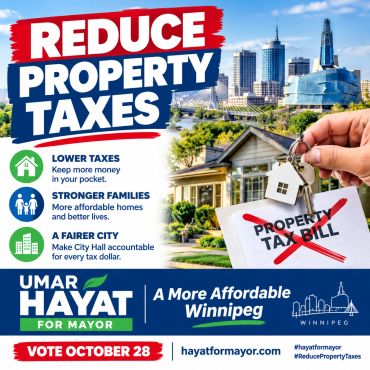
Hayat has called for a fundamental restructuring of Winnipeg's property tax system. He argues that the mill rate for neighbourhoods with higher infrastructure costs should reflect those realities β€” rather than the current system where tax dollars are often diverted away from the neighbourhoods that need them most. A neighbourhood with crumbling roads, failing sewers, and higher demands on police and paramedics should have a mill rate structure that accounts for those service demands, ensuring that tax dollars are reinvested where they are collected. Under the current system, the opposite is true. Hayat has pledged that under his leadership, tax dollars will be reinvested in the neighbourhoods where they are collected.

Transit Safety

Instead of static, vulnerable terrestrial camera networks, Hayat proposes using the same drones outlined in his Crisis Response Drones pillar to monitor major transit hubs. This approach is cheaper, more flexible, and more secure than fixed cameras, which can be vandalized or avoided. The MyWinnipeg App will also include a real-time safety reporting feature, allowing transit riders to report incidents instantly. Hayat will also work with Winnipeg Police to increase visible presence at high-risk stops, focusing on a drone-first strategy rather than outdated infrastructure.